Table of Contents
ToggleIntroduction
The Six Thinking Hats method has earned a respected place in decision-making, problem-solving, and business communication. It gives individuals and teams a structured way to think clearly and avoid emotional chaos or scattered thought patterns. Many organizations use it to reduce conflict, speed up meetings, and help groups reach better outcomes faster.
This method works because it simplifies complex thinking. Instead of jumping between emotions, logic, and creativity all at once, the Six Thinking Hats separates each mental mode into its own moment. That structure helps people understand themselves and others clearly, which leads to stronger communication and smarter decisions.
In a world filled with overwhelming information, bias, and pressure, the Six Thinking Hats system offers a practical path to thoughtful analysis. Each hat brings its own value, but when the six hats operate together, the method becomes a powerful decision framework. This article explains the Six Thinking Hats in detail, introduces six transformative skills connected to the system, and shows how to apply it in real-world situations.
1. The Concept Behind Six Thinking Hats
The Six Thinking Hats method was created by Edward de Bono, a pioneer in creative thinking. His goal was to give people a tool that encourages focused thinking instead of scattered conversation. Instead of arguing opinions, participants try on different “hats,” each representing a unique perspective.
This simple idea allows a team to shift from emotional thinking to logical thinking and then to creative thinking without confusion. The Six Thinking Hats method helps reduce conflict because everyone is thinking in the same direction at the same time. That structured alignment is what makes the method so effective in both personal and professional environments.
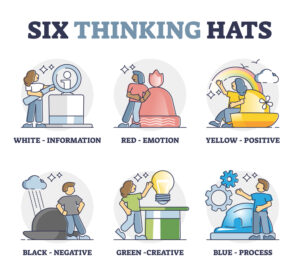
2. The White Hat: Neutral Facts and Information
The white hat represents pure information. When using this hat, individuals focus on data, statistics, verified sources, and factual statements. Opinions and judgments are set aside for later. This stability gives the Six Thinking Hats method its foundation because smart decisions begin with accurate information.
A white-hat session may include questions such as: What do we currently know? What information is missing? What evidence supports this idea? These questions build clarity and help decisions rest on a strong base of truth rather than assumptions.
3. The Red Hat: Emotions and Intuition
The red hat allows people to express their feelings openly without needing justification. Emotional responses are valuable because they often reveal personal concerns, motivations, or subconscious reactions. The Six Thinking Hats method creates a safe space for these emotions by dedicating a specific moment to them.
Feelings expressed under the red hat may include excitement, fear, confusion, or enthusiasm. By placing emotional expression into a structured stage, people avoid mixing raw emotion with logic, which keeps the decision-making process balanced.
4. The Black Hat: Risks and Caution
The black hat represents caution, negative possibilities, and critical evaluation. It is not pessimism but realistic risk assessment. Every idea, no matter how creative or exciting, should be tested for weaknesses before being implemented. That is why the black hat is essential within the Six Thinking Hats system.
Using the black hat helps teams identify flaws early, prevent costly mistakes, and anticipate challenges. It also ensures that decisions are grounded in practicality rather than blind optimism.
5. The Yellow Hat: Optimism and Benefits
The yellow hat focuses on the positive side. Under this hat, individuals search for benefits, opportunities, and strengths in an idea. Even risky concepts may include valuable potential that deserves attention. The Six Thinking Hats framework makes sure positivity receives its proper space.
This perspective encourages hope, motivation, and forward movement. Yellow-hat thinking helps balance the cautionary nature of the black hat and opens the door to meaningful improvement.
6. The Green Hat: Creative Expansion
The green hat represents creativity, alternatives, and new possibilities. When using this hat, participants dream openly and generate fresh ideas without judgment. This stage may include brainstorming, new combinations, unexpected solutions, or alternative directions.
The Six Thinking Hats method relies heavily on green-hat thinking to unlock innovation. Creativity flourishes when people feel free from criticism and pressure. This hat encourages imagination and encourages teams to explore what could be instead of what already exists.
7. The Blue Hat: Process Control
The blue hat is the management hat, responsible for guiding the thinking process. It sets the order of the hats, keeps discussions organized, and ensures every hat receives attention. Without the blue hat, the Six Thinking Hats would lose structure and drift into chaos.
This hat helps teams maintain discipline, stay focused, and follow an agreed-upon process. It is especially valuable during long meetings or emotionally charged topics.
8. Skill 1: Structured Thinking
One of the most important transformative skills linked to the Six Thinking Hats is structured thinking. People often jump from emotion to facts to creative ideas without realizing it. This scattered thinking leads to confusion. The Six Thinking Hats system teaches individuals to separate mental modes and approach each stage with intention.
Structured thinking reduces stress, speeds up decision-making, and results in clearer insights. It is a skill that strengthens personal organization and professional performance.
9. Skill 2: Emotional Awareness
Emotional awareness grows naturally through red-hat practice. Many people suppress or ignore emotions in decision-making because they appear irrational. However, emotions often point to deeper issues that deserve attention. The Six Thinking Hats encourages healthy emotional expression.
This awareness helps people understand their motivations and build stronger communication with others. Emotional clarity prevents misunderstandings and supports healthy collaboration.
10. Skill 3: Increased Creativity
Green-hat thinking strengthens creative capacity. Regular practice helps people become more imaginative, flexible, and open-minded. Creativity is not limited to artistic work; it plays a central role in problem-solving, strategy, and innovation.
The Six Thinking Hats system gives structure to creativity, allowing ideas to flow freely without interference from judgment. Over time, individuals learn to generate alternative solutions naturally.
11. Skill 4: Balanced Judgment
The yellow and black hats together teach balanced judgment. People often lean too heavily on optimism or caution. The Six Thinking Hats encourages a healthy blend of both, ensuring that decisions are neither overly risky nor overly safe.
Balanced judgment helps teams see the full picture and prevents biased decision-making. It also helps resolve conflicts between those who prefer cautious reasoning and those who push for ambitious ideas.
12. Skill 5: Improved Collaboration
The Six Thinking Hats enhances teamwork by giving everyone equal space to participate. Instead of arguing opinions, participants shift together through each hat. That shared direction eliminates personal attacks and reduces defensive behavior.
This leads to better cooperation, clearer communication, and a more respectful working atmosphere. Collaboration becomes smoother because everyone understands the expectations of each stage.
13. Skill 6: Faster, Clearer Decision-Making
The final transformative skill is the ability to make decisions more effectively. The Six Thinking Hats method shortens long debates and prevents meetings from going in circles. Each hat adds clarity, and the blue hat ensures that the process moves forward efficiently.
When teams follow the structure correctly, decisions become faster, sharper, and more confident. This is one of the main reasons the Six Thinking Hats method is widely used in business, education, and leadership.
References
De Bono Group – Six Thinking Hats
MindTools – Six Thinking Hats Overview
IFTF – Creative Thinking Methods